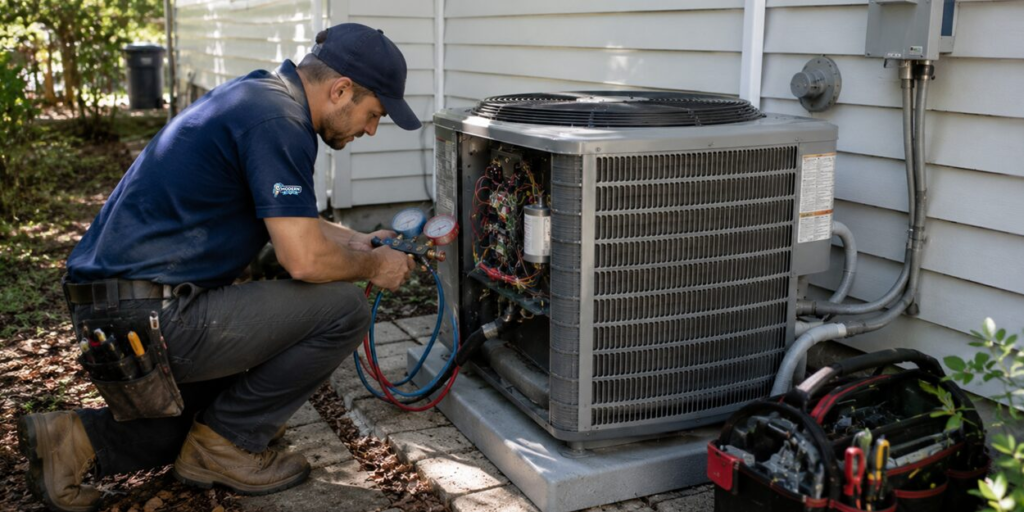
When your home gets too hot or too cold, it usually means your comfort system has a problem. Dealing with a broken heater or an air conditioner that only blows warm air can be stressful. Before panic sets in, it helps to understand how these machines work and what you can safely check on your own.
Many system issues come down to simple fixes like a dirty filter or a flipped switch. However, some problems require professional tools and training. Knowing the difference saves you time, money, and keeps your home safe.
How Your Home Comfort System Works?
To fix a system, you have to know what it does. Your heating and cooling setup moves heat from one place to another.
- Summer: The air conditioner takes the heat from inside your rooms and dumps it outside. It uses a special liquid called refrigerant (a cooling fluid) to absorb the heat and a fan to blow the cooled air through your home.
- Winter: Your furnace or heat pump creates heat or pulls it from the outside air, then pushes that warm air through your vents using a large blower fan.
When the system stops working, the problem usually lies in one of three areas: the air flow, the electricity, or the mechanical parts.
Step-by-Step Heating and Cooling Repair Checklist
When a professional technician walks up to a broken system, they follow a strict order of steps. They do not guess. They look at what the machine is doing and trace the issue from the easiest fix to the hardest. You can follow this exact same path to see if your system needs a basic adjustment.
1. Check the Thermostat Settings:
Look at the box on your wall. Make sure it is turned on and set to the right mode. If it is summer, it must say “Cool.” If it is winter, it must say “Heat.” If the screen is completely blank, open the cover and replace the batteries. A dead battery in a thermostat is one of the most common reasons an entire system shuts down.
2. Inspect the Main Power Switch:
Both your indoor heater and your outdoor cooling unit have dedicated power switches. The indoor switch often looks like a regular light switch located on or near the furnace wall. Ensure it did not get bumped into the “Off” position by mistake.
3. Check the Electrical Circuit Breakers:
Go to your home’s main electrical panel. Look for the switches labeled for your heater or air conditioner. If a switch has flipped to the middle or “Off” position, flip it all the way off first, then flip it back to “On.” If the breaker flips off again immediately, do not touch it anymore. This means there is a dangerous electrical short circuit, and you must get help.
4. Examine the Air Filter:
Locate your system’s air filter. Pull it out and hold it up to a light. If you cannot see light through it because it is caked with dust and pet hair, replace it immediately. A blocked filter stops air from moving. When air cannot move, the cooling coils freeze into a block of ice, or the furnace overheats and shuts itself down for safety.
5. Look at the Outdoor Unit:
Go outside and look at the big metal box. It needs plenty of open space to breathe. Clear away tall weeds, leaves, sticks, or plastic bags trapped against the sides. If the metal fins are covered in thick dirt or mud, gently spray them down with a garden hose. Never use a high-pressure washer, as it will bend the soft metal fins and ruin the airflow.
Common Air Conditioning Problems
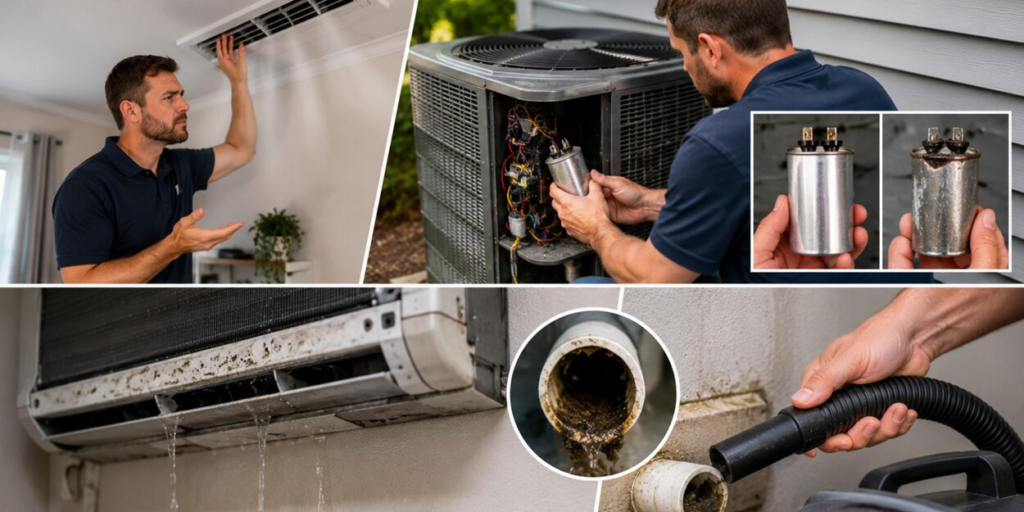
If you complete the basic checks and the machine still refuses to cool, the issue is likely deeper inside the components. Here is what happens behind the scenes during common breakdowns.
The System Runs but Blows Warm Air
If you hear the fans spinning but the air coming from your vents feels warm, the system cannot remove the heat. This often happens because the refrigerant level is too low.
Another cause can be a failed capacitor. It gives the heavy outdoor motor the big push of electricity it needs to start running. If the capacitor bulges or burns out, the fan might spin, but the cooling pump will stay off.
The Indoor Unit is Leaking Water
Air conditioners do more than cool the air; they also pull humidity out of it. This water flows outside through a narrow plastic drain pipe.
Over time, slime, algae, and dust can clog this pipe. When the path is blocked, the water backs up and spills over the sides of the pan. This can ruin your drywall and floors. Cleaning this out requires using a wet vacuum to suck the clog out from the outside end of the pipe.
Common Heating Problems
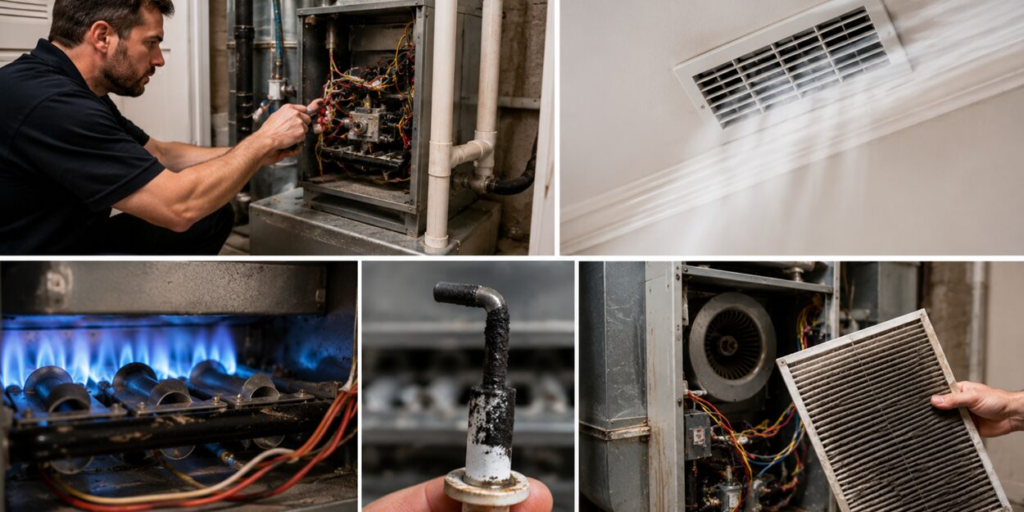
When winter arrives and the house drops in temperature, heating systems experience their own set of specific issues.
The Furnace Blows Cold Air
A gas furnace has a safety part called a flame sensor. Its job is to make sure gas isn’t being pumped into your home without burning. If the sensor gets covered in a thin layer of black carbon soot, it can no longer see the flame. It will shut the fire down within a few seconds of starting, leaving you with nothing but cold air blowing through the house.
The System Constantly Cycles On and Off
If your heater turns on, runs for two minutes, shuts off, and then repeats this cycle over and over, it is “short cycling.” This is almost always caused by overheating. If the internal sensors detect that the air inside the furnace is getting too hot, they cut the power to prevent a fire. Check your air filter first. If the filter is clean, the issue could be a broken blower fan that isn’t spinning fast enough to move the heat out of the metal furnace box.
When to Stop and Call an Expert?
Some fixes are easy to do yourself, like changing a dusty filter or flipping a power switch back on. But when those basic steps do not work, it is best to stop troubleshooting. Trying to fix complex electrical wiring or gas components on your own can be highly dangerous, and it can easily cause more damage to your expensive equipment.
For reliable heating and air conditioning, Riverside homeowners trust local technicians who understand the local climate and have the right tools for the job. When you need fast help to get your home back to a comfortable temperature, the experienced team at Modern Comfort and Air is ready to handle your repair needs correctly. Call or message today to schedule your service!Â
