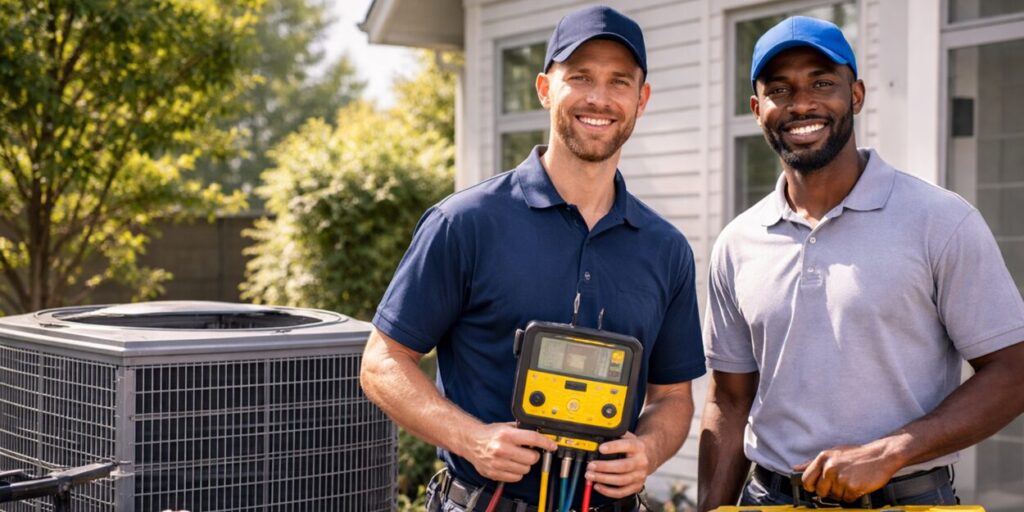
Your HVAC system controls comfort, air quality, energy bills, and even your family’s health. Yet most homeowners only start thinking about heating and cooling contractors when something breaks. And surprisingly, this usually happens during the hottest summer day or the coldest winter night.
The truth is that most HVAC problems are not equipment failures; they’re contractor mistakes. Poor installation, rushed diagnostics, or incorrect repairs can shorten system life, increase utility costs, and leave you paying for the same issue twice. That’s why learning how to choose an HVAC contractor is one of the smartest homeowner decisions you’ll ever make.
This guide combines real-world industry practices with lessons homeowners repeatedly learn the hard way. Let’s break it down step by step.
What Do Heating and Cooling Contractors Actually Do?
Before choosing one, understand their role. Professional heating and cooling contractors handle:
- System Diagnostics and HVAC Repairs
- Installation of heating and cooling systems
- Preventive servicing
- Thermostat setup
- Ductwork inspection
- Energy efficiency optimization
- Emergency breakdown repairs
They are responsible for making sure your system works safely, efficiently, and reliably.
Essential Requirements for a Heating and Cooling Contractor Near Me
Before looking at pricing or reviews, you must verify the legal and professional standing of any contractor. In the HVAC world, “low cost” often equates to “high risk.”
- Verified Licensing and Bonding: Every legitimate heating and cooling contractor must hold a state-issued license. Verify this number on your state’s licensing board website. If the license has expired or belongs to a different company name, do not let them enter your home.
- Proof of General Liability and Workers’ Comp: If a technician is injured on your property or causes a fire due to faulty wiring, you are liable if they are not insured. Demand a current Certificate of Insurance (COI) sent directly from their agent.
- NATE Certification: Look for technicians certified by North American Technician Excellence (NATE). This is the industry standard for technical competence in HVAC repairs and installation.
Common Mistakes to Avoid When Hiring for HVAC Repairs
1. Hiring Based on the Lowest Estimate
In HVAC, the installation is more important than the equipment. A budget contractor often cuts corners on vacuuming the lines, sizing the ductwork, or testing for leaks. These shortcuts lead to premature compressor failure and high utility bills.
2. Accepting a Quote Over the Phone
A professional cannot offer air conditioning repair services without seeing the equipment first. Any contractor who gives a firm price for a repair or replacement without an on-site inspection is guessing and will likely upcharge you once the work begins.
3. Ignoring the “Sales Tech” Business Model
Many large companies pay their technicians on a commission-only basis. This creates a conflict of interest where the tech is incentivized to criticize a repairable unit to sell you a new one. If a tech spends more time talking about financing than showing you the actual mechanical failure, get a second opinion.
Technical Benchmarks: What to Look for in Quality Air Conditioning Repair Services?
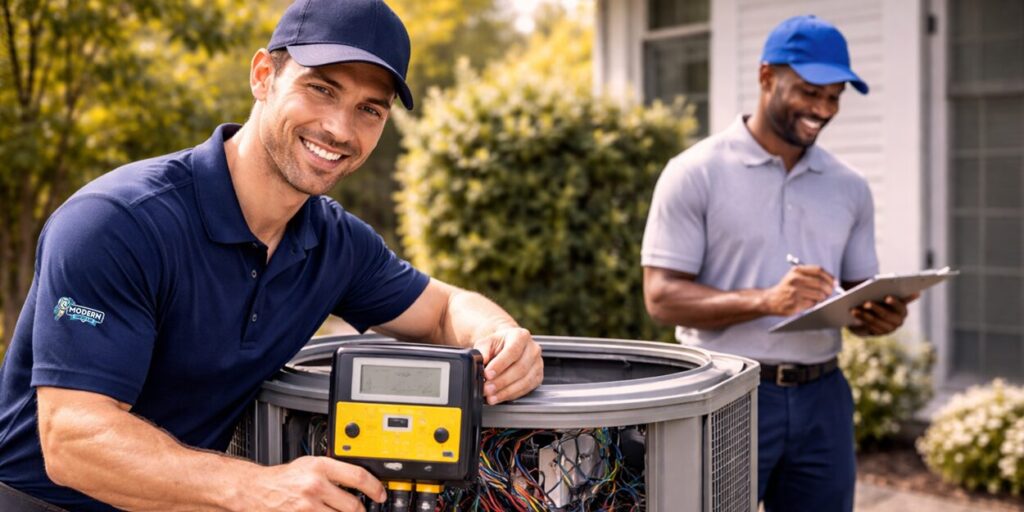
A high-quality repair is a scientific process. If your technician is not using the following tools and methods, they are likely performing guesswork:
- Digital Manifold Gauges: Instead of old analog dials, pros use digital gauges to get precise subcooling and superheat readings. This ensures your refrigerant charge is exact to the manufacturer’s specifications.
- Combustion Analysis: For furnace repairs, a technician must use a combustion analyzer to measure oxygen, CO, and efficiency levels. This is the only way to prove a system is running safely.
- Micron Gauges: During a replacement or major repair, the technician must use a micron gauge to ensure the system is dehydrated and sealed. A vacuum held at 500 microns is the industry standard for a clean system.
How to Evaluate HVAC Replacement Quotes?
If HVAC repairs are no longer viable, you will be pressured to buy new equipment. Use these criteria to ensure the new system is installed correctly:
Demand a Manual J Load Calculation
Never replace a system based on the size of the old one. Changes in windows, insulation, or home additions change your heating and cooling needs. A Manual J calculation is a room-by-room data analysis that determines the exact BTUs required.
Ask About Static Pressure
The best air conditioning contractors will test your home’s static pressure. This measures how hard the blower motor has to push against the resistance of your ductwork. If your ducts are too small, a new high-efficiency unit will burn out its motor in less than three years.
Check for Permit Filing
A reputable contractor will always pull a permit. This triggers a third-party inspection by the city or county to ensure the gas lines, electrical, and venting meet the latest safety codes. If a contractor asks you to pull the permit or says it’s not necessary, they are trying to hide their work from inspectors.
Professional Questions to Ask AC Repair Services
To filter out the amateurs, ask these three technical questions:
- Do you use a digital micron gauge when evacuating the system? (The answer should be “Yes”).
- Will you provide a written combustion analysis report for my furnace? (The answer should be “Yes”).
- What is your process for determining if a heat exchanger is actually cracked? (They should mention using a camera or a specialized dye test, not just looking at it.
The 50% Rule for HVAC Repairs
If you are struggling to decide between a repair and a replacement, use the 50% rule: If the cost of the repair (multiplied by the age of the unit in years) exceeds the price of a new system, or if the single repair cost is more than 50% of a new unit’s value, it is time to replace.
For example, a $1,000 repair on a 12-year-old unit ($12,000) is a poor investment compared to an $8,000 new installation.
Conclusion: Prioritizing Expertise Over Marketing
Choosing a contractor is about finding a technician who respects the trade. Avoid the companies with the biggest advertising budgets and focus on the ones with the best technical certifications and transparent, data-driven processes. By following this framework, you can ensure your home’s infrastructure is handled by professionals who prioritize safety and efficiency over a quick sale.
For homeowners who require high-performance HVAC solutions and honest, technical diagnostics without the sales pressure, Modern Comfort and Air provides industry-leading service and transparent repair protocols. So, schedule an inspection today and make comfort a long-term decision.
